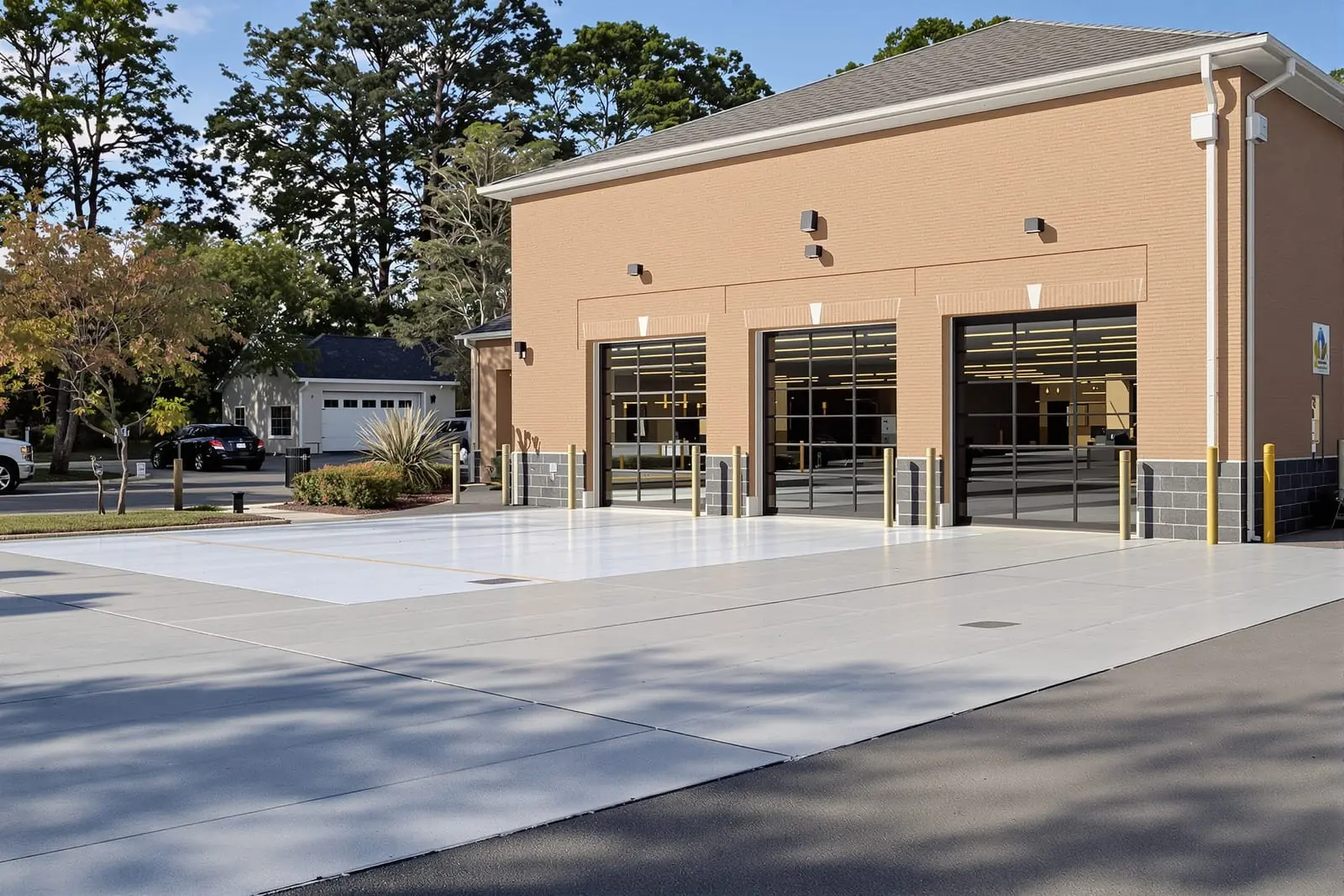
We pour commercial concrete slabs in Madison, WI for loading docks, equipment pads, dumpster enclosures, and more. Our slabs are designed for impact, point loads, and frequent traffic so they hold up over time. Get loading dock concrete and commercial slab installation that keeps your operations running smoothly.
Primetime Concrete Madison provides professional commercial concrete slab throughout Madison, WI and the surrounding area. Our licensed, insured crew delivers safe, clean, on-time work with a free estimate before anything begins. Call (608) 292-5067 or request your free quote.
Loading docks and commercial slabs built for Madison businesses
Primetime Concrete Madison designs and builds loading docks and commercial concrete slab systems that match how your business really works, not a generic plan from somewhere else. Whether you are unloading semis on the Beltline, running a light industrial shop on the East Side, or expanding a warehouse in Verona Road corridor, we focus on traffic patterns, equipment loads, and Wisconsin weather so your slab and docks hold up for the long term.
Most of our projects start with a walk-through of your site. We look at how trucks approach, how forklifts move, where snow piles up, and how water currently drains. From there we size the slab thickness, joint layout, and reinforcement to the actual loads you expect. A busy freight dock that sees 53 foot trailers and daily pallet jack traffic needs a very different design from a small shop that occasionally gets box trucks.
Because we work only in this region, we are very familiar with how frost, freeze-thaw cycles, and road salt affect commercial concrete. That local experience shapes every recommendation we make, from concrete mix design to how the dock face is armored against impact.
How we design a durable commercial concrete slab
A reliable commercial concrete slab in Madison starts with the soil. Our crew checks existing subgrade conditions and, when needed, coordinates soil testing. If we find soft spots, organic material, or poorly compacted fill, we remove and replace it with dense graded base or crushed stone, then compact in thin lifts to meet spec. Skipping this step is one of the main reasons slabs settle or crack prematurely.
Next, we determine slab thickness and reinforcement. For most loading docks and warehouse slabs, we are in the 6 to 8 inch range, sometimes thicker in heavy industrial or racking areas. We may use rebar, welded wire mesh, or fiber reinforcement, and often a combination. For example, a busy distribution center might get 8 inches of concrete with rebar in the loading zones and fiber reinforcement throughout the rest of the floor for added crack control.
We also plan the joint layout carefully. We map out sawcut control joints so that slabs are broken into predictable panels that can shrink without random cracking. At door openings, dock edges, and column lines, we place joints and reinforcement to keep those areas from spalling or shifting. These details matter more in our climate, where temperature swings are large and frequent.
Loading dock construction, step by step
A well built loading dock is a combination of structure, slope, and details that let drivers and warehouse staff work safely and quickly. After excavation and base prep, we form the dock face and slab with the correct elevations so trailer beds line up with your doors and equipment. We typically target a 4 to 5 percent slope away from the building so water and melted snow flow out to a drain or graded yard, not back toward your foundation.
We set any dock leveler pockets, curb angles, bollard footing locations, and embedded plates or anchor bolts before the pour, so you are not drilling into fresh concrete later and compromising its strength. For exterior docks, we usually specify air entrained concrete in the 4000 to 4500 psi range with a low water to cement ratio. This mix gives better resistance to salt, freeze-thaw cycles, and heavy point loads from trailer jacks.
On pour day we place the concrete, vibrate around rebar and embedded hardware, then screed and power trowel to the appropriate finish. In traction-critical areas, such as where snow and ice are common, we often recommend a broom or light textured finish instead of a glossy hard trowel, so forklift tires and boots maintain grip even when wet.
Finishing options for high traffic commercial slabs
Different operations around Madison need different slab finishes. In a warehouse or manufacturing floor, a hard troweled surface is common because it resists dusting and cleans up well with floor scrubbers. We can add a dry shake hardener in heavy forklift lanes or at dock approach zones to increase abrasion resistance.
For exterior loading areas and drive lanes, a broom finish is usually preferred. The light texture helps with traction in winter and makes it easier to see surface water so crews can avoid slippery spots. In some cases, such as food distribution or cold storage facilities, we add a slightly heavier broom or a textured trowel finish to limit slickness when condensation forms.
For businesses that may later add epoxy or urethane coatings, we adjust the finishing process so the surface profile is compatible with those systems. We also discuss curing methods early, since curing compounds, wet curing, or blankets each have different impacts on how later sealers or coatings bond.
Cold climate and Madison specific considerations
Madison properties deal with frost depth, snow storage, plowing, and deicing chemicals, and those factors all influence how we build your loading docks and commercial slabs. We often extend slab edges beyond the dock face to handle plow blades and snow piles without breaking off corners. In areas where snow is routinely stacked, we may thicken the slab and increase reinforcement to resist the added loading and freeze-thaw stress.
We design concrete mixes with air entrainment and carefully controlled slump so they can resist scaling from road salt. At entrances and dock aprons, we pay special attention to drainage to reduce standing water that later forms ice sheets. If your site has existing drainage issues, we can incorporate trench drains, added catch basins, or regrading into the slab project.
Winter construction is common in our area. When work must happen in cold weather, Primetime Concrete Madison uses heated blankets, temporary enclosures, and warm mix water to keep concrete within safe curing temperatures. We advise commercial clients on which portions of a project should wait for mild weather and which can safely proceed with cold weather procedures so your schedule is protected without sacrificing quality.
What drives cost for a commercial concrete slab project
Commercial slab and loading dock pricing is driven by more than just square footage. Thickness, reinforcement type, subgrade corrections, and site access are usually the biggest factors. A 5 inch slab on good soil with fiber reinforcement will cost less than an 8 inch slab with full rebar mat over poor existing fill that needs to be replaced.
Existing conditions around Madison vary a lot. Older industrial sites sometimes have unknown buried debris or thin concrete that must be removed. Newer business parks may have engineered fill but still require proof rolling or undercutting in soft areas. We walk you through these possibilities before you budget, so surprises are minimized.
Add-ons like dock leveler pockets, retained edges, curbs, bollards, and embedded rails or tracks also affect price, but doing them during the initial pour is almost always cheaper than retrofitting later. Primetime Concrete Madison provides itemized proposals that separate structural work from optional features, so you can decide what belongs in phase one and what can wait without compromising safety or performance.
Our process when you partner with Primetime Concrete Madison
When a Madison area business contacts Primetime Concrete Madison about loading docks or a commercial concrete slab, we start with a conversation about how the space will be used over the next 5 to 10 years, not just the day it opens. That includes expected equipment upgrades, changes in truck sizes, potential tenant changes, and any city or fire code considerations that touch the slab area.
We then visit the site to measure, evaluate access, and check drainage and elevations. You receive a clear scope that lists slab thickness, reinforcement, concrete strength, finish type, joint spacing, and all embedded items. Timelines are coordinated with your operations so downtime is minimized, and for active facilities we often phase work to keep at least one dock operating.
Throughout construction we keep communication straightforward. You know when demolition, forming, pouring, and curing will happen, and when forklifts and trucks can safely return to service on the new concrete. Our goal is that you end up with a slab and dock system that feels like a permanent upgrade to how your operation runs, not just a patch to get through the next couple of seasons.
“
Professional loading docks & commercial slabs, done right the first time, quality materials, honest pricing, and results that last.
Primetime Concrete Madison
Loading Docks & Commercial Slabs Across Our Service Area