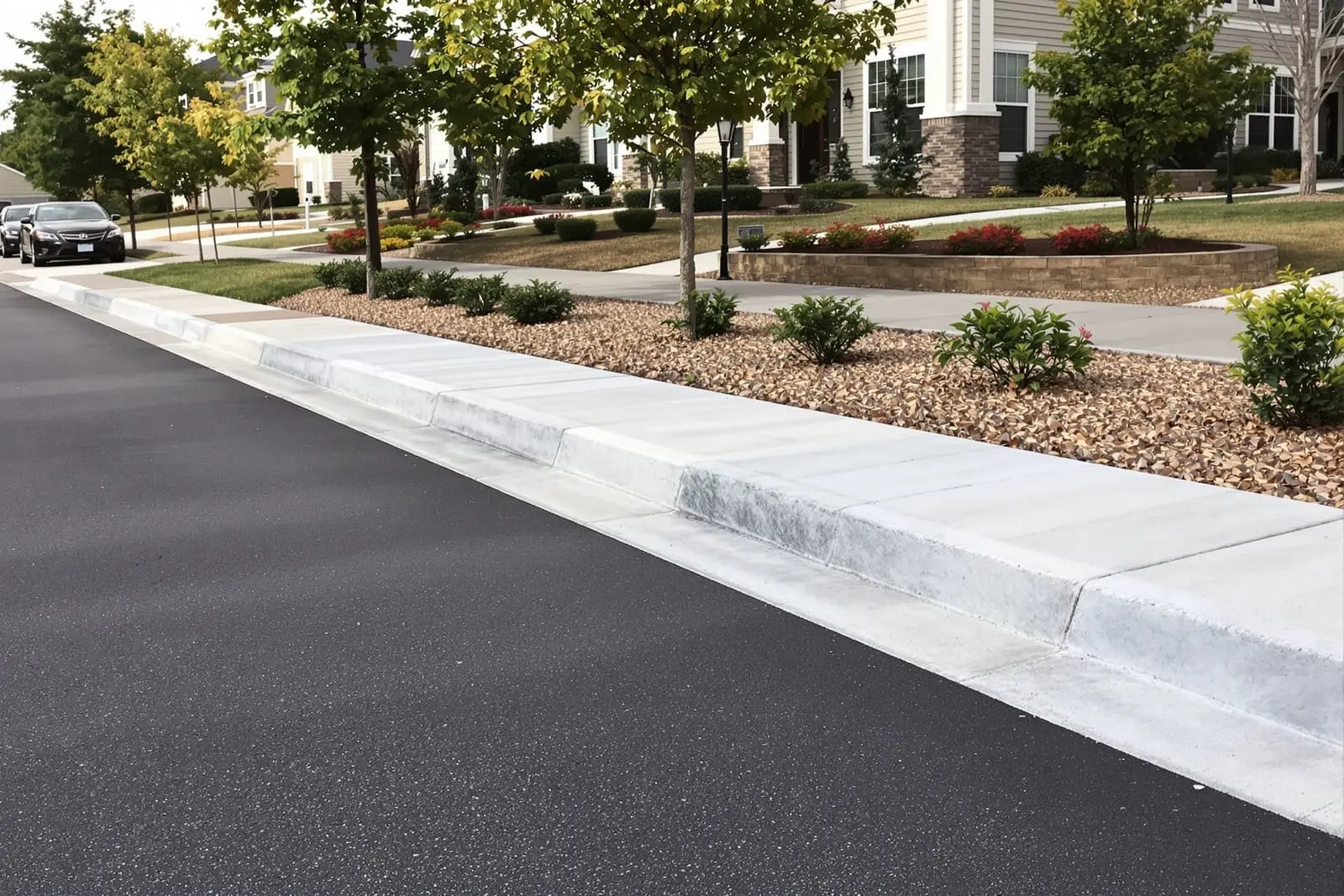
We install concrete curb and gutter in Madison, WI for parking lots, access roads, and commercial sites. Properly formed curbs, gutters, and concrete barriers help manage drainage and protect landscaped areas. Improve traffic flow and site safety with durable concrete edges and protective structures.
Primetime Concrete Madison provides professional concrete curb and gutter throughout Madison, WI and the surrounding area. Our licensed, insured crew delivers safe, clean, on-time work with a free estimate before anything begins. Call (608) 292-5067 or request your free quote.
Concrete Curb and Gutter Work in Madison, Done the Right Way
Primetime Concrete Madison installs and repairs concrete curb and gutter systems that actually work for Madison streets, driveways, alleys, and parking lots, not just on paper. Our focus is simple: control water, protect pavement edges, and stand up to Wisconsin freeze-thaw cycles.
We start every project with a site walk. We check existing drainage patterns, how water currently moves during storms, and where ice tends to build up in winter. On many older Madison properties, we find low spots where gutters hold water, or curb sections that have heaved and now direct runoff toward garages or foundations. Catching those issues before we pour concrete is usually the difference between a curb line that lasts 30 years and one that fails in 5.
Our crew is used to tight urban sites on the isthmus, sloped driveways on the west side, and mixed-use lots around commercial corridors. We adjust curb type, gutter slope, and joint layout to fit each location, instead of forcing a standard detail that might look right but drain poorly once the snow and slush arrive.
How We Build Curbs, Gutters, and Barriers Step by Step
For most concrete curb and gutter jobs, we follow a repeatable but flexible process so you know what is happening on your property and why.
1) Layout and grade check: We mark the new curb line and set elevations with a laser level. In Madison, city curb and gutter work must match or correct existing street elevations, so we coordinate carefully where your private work ties into public right of way. For private lots and driveways, we set gutter slopes that move water to planned outlets or safe discharge points.
2) Excavation and base prep: We remove the existing asphalt, concrete, or soil where the curb and gutter will sit, then compact the subgrade. Where the soil is soft or wet, which is common in low areas near Starkweather Creek or Lake Monona, we may add crushed stone base and compact in thin lifts to limit future settlement.
3) Forms and reinforcement: We install steel or wood forms to the final line and grade, checking straightness with string lines and matching driveway or sidewalk connections. On heavy-traffic areas, such as commercial entrances or dumpster pads, we often add rebar dowels at pavement joints or a continuous bar in the curb to help control cracking.
4) Concrete placement: We typically use a 4000 to 4500 psi air-entrained mix designed for freeze-thaw and deicing salts. Concrete is placed, consolidated, and shaped with curb machines or hand tools depending on project size. We pay close attention to the gutter pan, since this is where standing water and ice will form if the slope is off even slightly.
5) Finishing and control joints: We broom-finish the gutter for traction and tool joints at set intervals to control where cracks appear. At driveways or sidewalk crossings, we adjust the curb profile to create compliant ramps and smoother transitions.
6) Curing and protection: We apply curing compound or cover sections to hold moisture in, then keep traffic off until strength is adequate. For residential driveways, we typically recommend keeping vehicles off new curb and gutter for at least 7 days in warm weather, longer if temperatures are cool.
Material Options and Profiles That Make Sense in Madison
Concrete curb and gutter is not one-size-fits-all. Primetime Concrete Madison helps you choose profiles and materials that match the use of the area, local requirements, and your budget.
For residential driveways and private roads, we often install standard barrier curb with a formed gutter pan. This gives strong edge support to asphalt or concrete pavement and directs runoff to the street or to swales. In neighborhoods that require a softer look or easier vehicle access, we can form mountable curb profiles that allow tires to ride up without chipping the concrete.
Commercial sites, multi-unit housing, and industrial yards may need heavier-duty curb and gutter. In loading areas, around dumpsters, and along truck routes, we typically increase concrete thickness at the gutter pan and add reinforcement or dowels into adjacent slabs. We also look at turning movements so trailer wheels do not constantly ride on exposed curb corners, which reduces chipping.
Where snowplows are common and tight to the curb, as in parking lots or along private access drives, we adjust curb height and nose shapes to reduce plow damage. We also review how deicers are used on site. Air-entrained, properly cured concrete resists salt better, but we can also recommend sealers or mix design changes if your site sees heavy chemical exposure.
For owners concerned about appearance, we can integrate curb and gutter with decorative flatwork. That might mean matching exposed aggregate or colored concrete sidewalks while still using standard gray curb and gutter where durability and replacement cost matter most.
Concrete Barriers, Edge Protection, and Safety Applications
Beyond standard curb and gutter, Primetime Concrete Madison installs concrete barriers and edge protection for safety, traffic control, and property protection.
We build cast-in-place barrier walls and curb-height barriers to separate pedestrian areas from vehicle paths, protect building corners from vehicle impact, and define loading zones. These are common around multifamily garages, drive-thru lanes, and near roll-up doors in light industrial buildings.
For parking lots near busy Madison streets, such as lots backing up to arterial roads, we design and pour barriers that help prevent vehicles from rolling out onto sidewalks or into traffic. The height, thickness, and reinforcement depend on expected vehicle types and local code requirements. We discuss whether you need a full crash-rated wall, a parking stop style barrier, or a hybrid solution that ties into your curb and gutter.
We also address snow management with barrier layouts. A barrier that looks good in summer can create wind-driven drift issues or block snow storage in winter. Early in design, we talk with owners or property managers about where plowed snow will go, and adjust barrier breaks and curb openings so winter maintenance is practical.
What Affects Cost and Timeline for Curb, Gutter, and Barrier Work
Cost on concrete curb and gutter projects in Madison is driven by more than just linear footage. Understanding these factors helps you plan and budget realistically.
Site access: If we can get trucks and equipment close to the work, costs stay lower. Tight backyards off narrow alleys or dense downtown lots may require smaller equipment, concrete pumping, or more hand work. That adds labor time and sometimes staging costs.
Demolition and subgrade: Removing old curb, asphalt, and unsuitable soil can be straightforward or very involved. Areas with thick, failed asphalt or saturated clay subgrade need extra time and base stone. When we bid, we explain what we see and where we might run into hidden problems so there are fewer surprises.
Thickness, reinforcement, and mix: Heavy-duty commercial curb and gutter with thicker sections, rebar, or dowels will cost more per foot than light-duty residential work, but may save you in repairs later. Higher strength or specialty mixes can be justified where trucks are frequent or where deicing chemicals are heavily used.
Phasing and traffic control: If the work must stay open for partial use, such as keeping one entrance to a business open at all times, we may need to phase pours, add temporary ramps, or coordinate with traffic control contractors. That planning time and extra mobilizations affect cost.
Season and weather: In Madison, outdoor concrete work is heavily weather dependent. Late fall or early spring projects might require cold-weather measures like blankets, accelerators, or tenting. We schedule pours to avoid freezing risk as much as possible, and if cold-weather work is unavoidable we explain the added steps and costs before we start.
Choosing Primetime Concrete Madison and What to Expect
When you hire Primetime Concrete Madison for concrete curb and gutter or barrier work, you get a crew that focuses on practical details and long-term performance, not just appearance on day one.
Before work starts, we review your site plan, drainage needs, and any city or county requirements that apply. For projects tying into public sidewalks or streets, we help you navigate permits and inspections so the curb line, gutter slopes, and sidewalk ramps pass review the first time.
During construction, you will know where access is restricted, how long areas must stay closed, and what to expect with noise and dust. We coordinate with paving contractors, landscapers, and utility crews when needed so your project stages make sense and you are not paying to redo finished work.
After the pour, we walk the site with you, check drainage performance with a hose when appropriate, and point out control joints and expected hairline cracks so you know what is normal and what is not. We also provide straightforward guidance on when you can drive on new curb and gutter, what deicers to avoid the first winter, and what simple maintenance will extend the life of your concrete.
If you are planning new construction, replacing failing curbs, or correcting drainage problems around your Madison property, we are available to look at the site, explain options in plain language, and give you a clear, written scope for the curb, gutter, and barrier work involved.
“
Professional curbs, gutters & concrete barriers, done right the first time, quality materials, honest pricing, and results that last.
Primetime Concrete Madison
Curbs, Gutters & Concrete Barriers Across Our Service Area